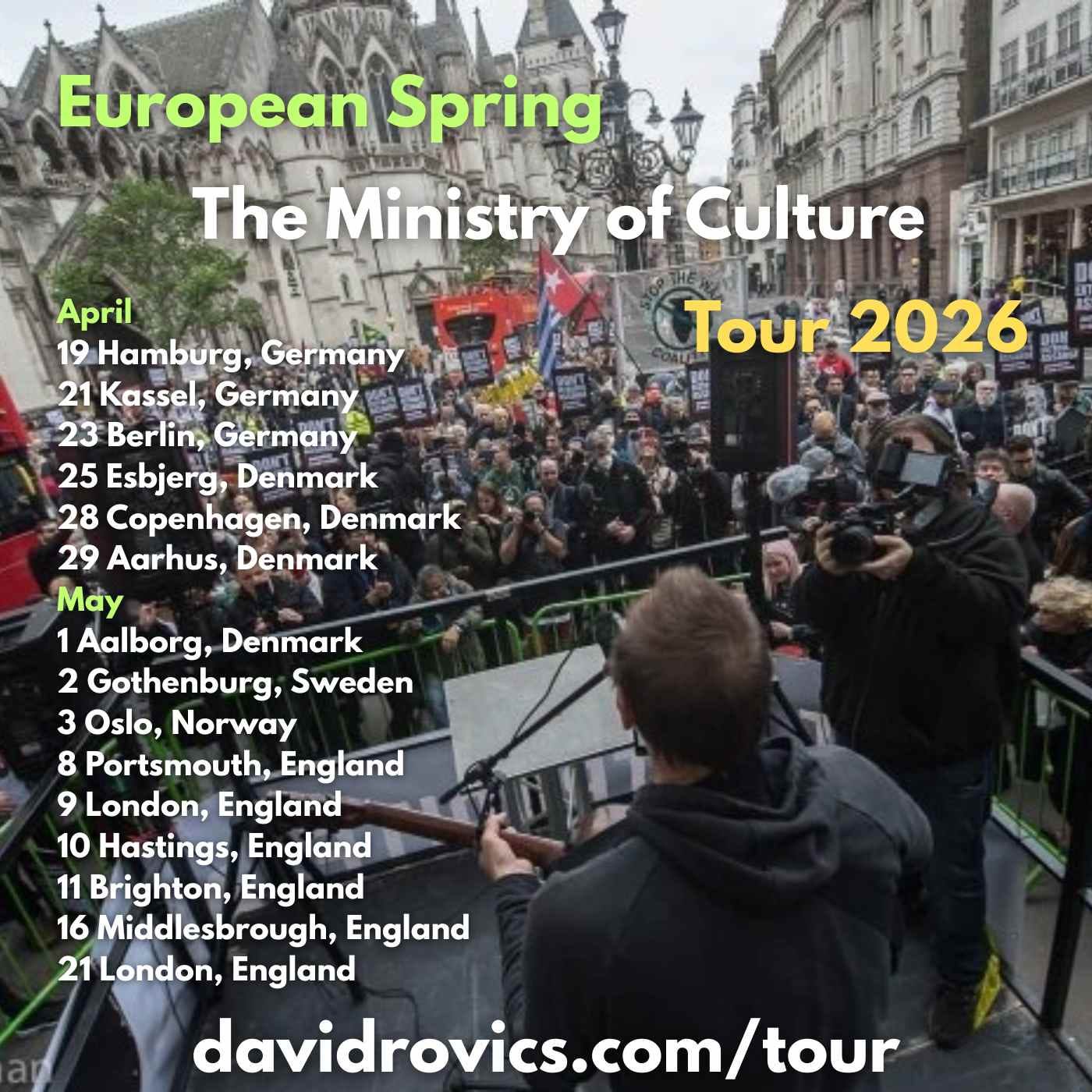

As the US and Israel jointly pursue Armageddon, I wait for the calls from protest organizers looking for live performers to make their protests engaging, for the movement they’re desperately hoping to build. But these calls never come. Not just since the end of February, but for many years now.
The occasional protests that do happen are carefully-managed, with no room for live music, which can be unpredictable at times. The bigger protests that happen in recent years are almost always the ones being promoted heavily on NPR and by social media algorithms. The bigger protests in recent years are never about US foreign policy.
It’s always easy to know what needs to be done. The hard part is in the implementation. We need a big, radically inclusive social movement with a vision for the kind of internationalist, egalitarian society we want to build, and the movement needs to be rooted in a shared love of human culture -- music, poetry, puppetry, food -- so it’s attractive and might stand a chance of growing even bigger.
This movement, naturally, needs to be opposed not only to terrible domestic policies like violently rounding up and deporting our neighbors and trying to form a dictatorship, but also opposed to a foreign policy based on threatening, sanctioning, and bombing other countries around the world -- particularly Iran, and by virtue of the client state relationship, any other country Israel occupies or attacks.
I know I’m not the only one noticing that while the ongoing ICE raids have inspired a lot of resistance, not only grassroots but also among all sorts of celebrities and politicians, this has hardly been the case with opposition to Israel’s wars on its neighbors, or the current war on Iran.
This reality dramatically highlights the conundrum anyone is in who might hope the way out of this madness could come from the leadership of the Democratic Party. Listen to the Democratic Party politicians and DNC-affiliated press outlets talking about military tactics with war hawks, rather than asking what the hell the US is doing bombing schools, hospitals, water desalination plants, and oil refineries.
Our leaders for the movement we want won’t come from that crowd.
But what of the other potential elements of society? People often wonder aloud in my presence about things like when the labor movement might step up to the plate, or the students, or Muslims, or “the left,” or some other group like that. I often wonder about that, too, even to the point where I start to come up with answers to my own questions -- some of them gathered from decades of observation and participation.
In the hope that it’s true that in order to try to answer the “now what?” question we must first understand the “what happened?” question, here are my broad generalizations that attempt to explain how we got here. That is, to explain a little about why antiwar sentiment does not seem currently to be represented by an antiwar movement, and to help answer the question of what happened to effective grassroots movement-building tactics.
There are various reasons why different groups or segments of society become sort of institutionally incapable of effective organizing. No small part of this process is related to constant, ongoing efforts on the part of various actors to misdirect and otherwise divide and conquer any real or potential threats to the status quo. (Look up “Cointelpro” for more information on that.)
I don’t know where the leadership we need in terms of a big, well-organized, radically inclusive, visionary, culturally-rooted social movement is going to rise out of. Sometimes, as has often and accurately been said, the darkest hour is just before the dawn. But here are my thoughts on some of the places some people often seem to be looking towards for this kind of leadership, and why we’re unlikely to find what we’re looking for in those places.
The labor movement
In the 1930’s in the US, the labor movement was where it was at. The movement was pervasive throughout society, influential in every possible way, and greatly dependent on art and music to communicate its message. Led by former members of the old Industrial Workers of the World who had joined the Communist Party, formally-organized unions and informally-organized movements connected to them were the order of the day, and led directly to the New Deal reforms of the era.
But the circumstances that arose around World War 2 and its aftermath proved to be too much even for this powerful, internationalist, often revolutionary movement. With the anti-communist, post-World War 2 backlash represented by McCarthyism and McCarthy’s House Unamerican Activities Committee, the communists were purged from the leadership of the labor movement. With the rise of the US as the world’s manufacturing base for much of the next generation, the labor movement’s leadership was overwhelmingly won over by the many good union jobs provided by the military-industrial complex. With the passage of the Taft-Hartley law banning solidarity strikes, the labor movement was also extremely hampered.
It has never really recovered from the post-World War 2 purges. The US labor movement has never, since the 1930’s, been at the forefront of any social movement. At worst, labor leadership has often been on the wrong side of many issues. In the 1960’s, the antiwar protesters who got beaten up were often being beaten by members of especially patriotic labor unions, in fact.
In the late 1990’s there was a resurgence in the labor movement connected to the global justice movement that was active in so many different countries then. 9/11 took the wind out of the sails of that movement, particularly in the US.
The boomers
People often look at things from a generational perspective. I’d say this orientation exists partially because it’s real -- people are shaped by the times they grew up in and the events that took place during those times. Partially it’s also wrapped up in the manufactured, corporate cult of youth that has existed for a very long time. It’s a cult that is both very profitable in terms of marketing products and services, and also very useful in terms of keeping the population divided from each other by age and other categories.
Certainly one of the very most useful and impressive social movements that happened in the twentieth century was the antiwar movement of the late 1960’s and early 1970’s. This extremely culturally-rooted movement used music and other forms of art as a means of demilitarizing the hearts and minds of so much of their generation, and so much of society in general.
Everything the boomer generation was thought to stand for in the context of the antiwar movement has been ridiculed and vilified ever since that time, so threatened were the powers-that-be by this movement and how it operated so effectively. Efforts were made ever since to make sure we have negative associations with this movement, and all of its methods, all of which have been portrayed as unrealistic, utopian, and ineffective, despite all of the abundant evidence to the contrary.
Despite all of these efforts, it was this generation -- or significant elements from it -- which took the helm of the antiwar movement when the US invaded Afghanistan and then Iraq after 9/11.
Since the movement against those wars and its boomer leadership, efforts to vilify and ridicule the 1960’s movement the boomers are still associated with increased exponentially with the rise of social media, and the algorithms the social media corporations use to effectively brainwash, divide, and conquer our society and so many others. The boomers are now too old to be leading anything, but the anti-boomer propaganda continues full tilt, lest anyone else be fool enough to try to engage in the kinds of organizing many boomers did so well -- helping to generate a tremendous antiwar movement using art, music, free festivals, free love, antiwar coffeehouses next to every military base with live music and free literature, among other tactics.
Generation X
Nobody actually talks about Generation X as a potential savior, but given that I’m a member of this generation... As with any other generation, it’s inaccurate to characterize it politically in one way or the other, it’s much too big and diverse for that, as they all are. But there are common lived experiences that can shape people and entire generations profoundly.
We are the first generation alive today to experience a nation in continual decline in terms of standard of living and hopes and expectations for the future. We are the last generation alive that didn’t grow up on social media. Both of these could be hopeful things. We’re also currently middle-aged, and largely very preoccupied with trying to pay the rent and raise children.
The youth
People younger than Generation X have grown up not only in a nation in decline, but in a country where our communications have been hegemonically hijacked by Big Tech and the ruling class interests it serves.
There has long been a cultural idea that “the youth” are the future, they’re the generation to look to for leadership in any potential social movement that might develop, and they’re also the generation that, as a result of growing up with all this technology, are the most astute about the whole tech-dominated situation we find ourselves in.
These assumptions have often proven false. For example, it wasn’t the youth that led the antiwar movement circa 2003, it was the boomers.
As a result of growing up within the confines of the social media reality that has been shoved down all of our throats, I’m not sure why anyone imagines that the generation most directly devastated by this onslaught would be in a good position to lead the resistance against it. Rather, this generation has been probably more dramatically impacted by the worldview presented by a very divisive interpretation of identity politics than any other, because of the nature of the online reality established by Big Tech by the late 2000’s.
The Left
To be clear about terms, when I say “the left” I’m talking about organized elements of society who are politically too radical to be part of the fold of the Democratic Party establishment. If you want to de-fund the police, close the US military bases around the world, welcome refugees, have reparations for slavery, seriously regulate the housing market and make housing a human right, if you are in a party or other organization that includes words like “socialist,” “communist,” or “anarchist” in the name.
In other countries these sorts of politics are sometimes actually represented by parties that have legislators in parliaments. In the US these sorts of values exist almost exclusively outside of electoral politics.
Being outside of electoral politics would not itself be a big limitation, in terms of forming a social movement focused on these values. But overwhelmingly, the organized left in the US, as well as the left represented by popular sentiments expressed on social media platforms, has long been hobbled by endless internal debates around issues of identity.
The pattern that has become well established in the social media age in particular is whenever a person or group rises to the fore in some way, they are cut down by the all-pervasive social media rumor mill for having the wrong identity, or the wrong orientation towards another identity. This way ties of common goals are broken, and the arguments never stop.
Whether we’re talking about groups that may fall under the rubric of identity politics or groups that orient more towards socialism, the environment, opposition to militarism, etc., the left in the US today has also become institutionally incapable of organizing an event that isn’t depressing (with the very occasional exception, of course).
Every protest now, small or large, for years, with rare exceptions, is bereft of live music, in a scene bereft of artistic representations of the people’s will. On the stage is one speaker after another, overwhelmingly people who are going to lecture the assembled crowd about how things are, tell us things we already know, criticize us for not being active enough or numerous enough, and then we all go home.
Probably more than any other part of society, the US left has convinced itself that the intense dependence on art and music as tools for organizing and communicating that every previous significant social movement have embraced is not relevant for us today, somehow. The boomers, though largely now dead, are still vilified and ridiculed, as is anyone with an acoustic guitar, despite the acoustic guitar still being one of the most popular instruments for people in the US to play, of any generation.
Every element of organizing effective events that foster a sense of community, inspire people to action, and leave people feeling optimistic about this movement is missing, as if systematically.
The methodically horrific way these demonstrations almost always go is evidence of a left that has been captured and rendered flaccid.
Muslims
Here we are in a situation where, once again, the US is at war with a number of predominantly Muslim nations. To say that the US is at war with a Muslim nation is akin to saying the sun rose in the east this morning. In many countries in what we call the western world, such as in the UK or Australia, the resistance to US and Israeli policies is led by Muslims.
Those of us who were politically active prior to 9/11 will remember that in the year following the beginning of the Second Intifada -- between September, 2000, and September, 2001 -- Muslims and Arabs across the US were very politically engaged in supporting the Palestinian uprising and opposing Israel’s expansionist, ethnonationalist, and racist policies. Events organized by Muslims during this period, from my direct recollection, almost always involved music and dance. I sang at innumerable events at this time, to take one of many such examples.
After 9/11 this all changed dramatically, as the security state went into high gear vilifying Muslims, putting them on no-fly lists, infiltrating mosques and other organizations, imprisoning solidarity activists on scurrilous charges, etc.
With Israel’s more recent policy of genocide in Gaza and daily pogroms across the West Bank, many Muslims and Arabs in the US got politically engaged again, along with other people, and the policies of both Biden and Trump has been to criminalize their speech and, if they’re not US citizens, to deport them.
With this kind of targeted repression, counting on a movement in the US to be led by elements of this country’s relatively tiny Muslim minority seems unlikely.
Students
In very recent years, students have been at the forefront of resistance to Israeli and US policies. Student leaders have been deported when they have not been citizens, with these policies impacting huge numbers of people in very dramatic ways. But US citizens have also faced expulsion and other very dramatic consequences.
It is not at all surprising that the student movement in 2024, even at its height, was mainly to be found in the bigger universities with either a significant Muslim or Jewish student population. The movement was largely led by students so directly affected that they couldn’t bear to look the other way.
That this was the case -- that this movement was not led by students who were just concerned about a war their country was very much involved in, but by Muslim and Jewish students -- was not at all surprising to me, given the stifling atmosphere that has now been present for many years on college campuses when it comes to anyone expressing an opinion on something that doesn’t somehow align with their perceived identity.
By my observation college campuses were central to resistance movements up until the funding on campuses across the country became less and less accessible to student groups, which thus had a harder and harder time organizing events, and this all happened to coincide directly with the rise of social media, circa 2006. Up until 2006, this particular artist was playing shows on college campuses across the US constantly, often over a hundred of them in a given year.
Immigrants
Immigrants generally have faced the same kind of blanket repression in the US that Muslims and Arabs have faced, particularly since 9/11.
At other times in history, massive social movements in the US have been led by immigrants, or have had a disproportionately large immigrant element, such as the Industrial Workers of the World over a century ago. All of the immigrant-led movements, such as the IWW and later movements such as those in the 1960’s -- La Raza Unida, the farmworkers union, the 2006 uprising that nobody remembers -- were all intensely musical, and effective.
Immigration was long favored by the leaders of industry, because it meant a ready source of cheap labor that they could use to prevent workers from organizing and demanding better pay and conditions. When this strategy failed badly with the rise of the IWW, lots of laws were passed that made immigration much harder, especially from the parts of Europe where the biggest trouble-makers were thought to be from.
While the campus protests in recent years may not rise to the level of participation we saw in the labor movement a century ago that inspired the anti-immigration legislation of the period, the response to the campus protests in terms of harshly punishing participants and passing laws to harshly restrict immigration from certain countries has been identical, and has effectively silenced a whole lot of people.
In conclusion
Who will take the lead in delivering the kind of movement so many of us are hoping for? You tell me. I have no idea. What I do know is most massive social movements that rise up and change everything were not predicted by the intelligentsias of their times.